

Why Pride?
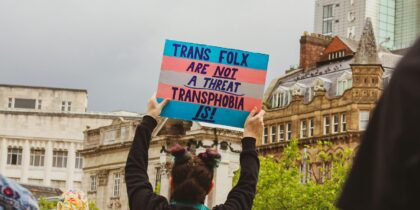
June marks Pride Month in the UK which is always a period of both celebration and reflection. It is a moment to think about the relative privilege it is to celebrate Pride, in a world where many cannot. It is a time to seek a sense of solidarity and safety with our community, a safety that often feels increasingly precarious in the UK and for some is a fiction – take for example the recent developments affecting trans and non-binary people we wrote to the Government about last week.
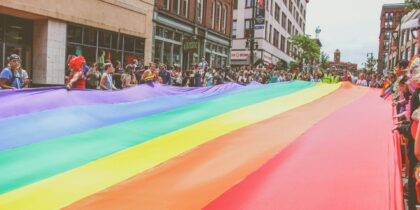
To me, as a gay man, Pride is an opportunity to restate that we exist today and always have existed, that we have rights, that we have a political voice and we demand respect and dignity. It is an opportunity to remind others – allies and opponents alike – that whilst more people outwardly accept us now, that isn’t universal or to be taken for granted. And even if we did live in a country and world where we could live completely freely and safely, many of us continue to live with the harms from pasts when that was not the case.
The connection between my mental health and sexuality
My mental health and sexuality are inseparable. Both are parts of my identity and my lived experience which have impacted on each other. I cannot discuss my mental health without reflecting on the harm and trauma I experienced when a teen and young adult because of other people’s homophobic attitudes. Nor can I discuss my sexual identity without reflecting on how my mental health has informed what parts of myself I feel most comfortable with or feel shame about, which aspects of my identity I choose to share with others.
It has taken me until my 40s, and consistent access to talking therapies, to really help me understand how deeply these two things are connected. It has also made me realise how lasting the impact of that experience in my formative years was. How it has had, and still has, an impact on my wellbeing and mental health today.
It is also a reminder of what ‘being open’ about our mental health really requires. Take work for example, where the social and legal norm is increasingly that we should share, not just a diagnosis, but the many things that make life and work harder for us. But for many of us, being truly open about the things that make life and work harder would involve us outing ourselves. Even if you are out, it’s not always safe (or deemed work appropriate) at work to discuss our identities and experiences beyond simple labels. So, many of us have resigned ourselves to only sharing some parts of ourselves only some of the time, or only with some people, and as a result only receiving some understanding and some of the support we need.
The coming out process
The term ‘coming out’ is now commonly understood to relate to revealing your sexual or gender identity. It describes, yes, the moment you tell someone who you are, but it also describes the period before that, the time when you were trying to work out exactly who you are, well before you told anyone else.
For me, ‘coming out’ as gay has been uncannily similar to ‘coming out’ as having a mental illness. First came the first inkling there was something different about me, but unsure exactly what, something that affected how I experienced the world that no one else knew. Then came the slow realisation about what that was: it took me a few years to realise I was gay and decades to realise I was living with mental illness. In both cases I experienced immense relief in finding a label, or diagnosis, that clearly and simply expressed who I was. Something that gave me an answer to the question: what is this thing that I am feeling?
For both, this was accompanied by a growing, but fragile, acceptance of who I was followed by a burgeoning pride. An increasing sense of self-assurance, of self-advocacy and openness, demanding my rights and dignity.
I am now openly and proudly a gay man living with mental illness. I know who I am and I know my rights, but in both regards, this self-acceptance hasn’t resulted in full acceptance from others. I still confront, all too frequently, the negative attitudes of others. I may accept myself, but I can’t rely on others trusting or accepting me when I tell them who I am.
The politics of mental health and equality
I wrote in The Guardian recently about how my experience growing up gay in east London in the 90s, and how the luck I had of such loving parents led me to want to turn that experience into changing things. I spent the first decade of my career (2005-15) working at Stonewall, fighting for equality and taking on the laws, practices and people who sought to deny us equality and dignity.
I, likewise, joined the Centre for Mental Health as I want to shift how mental illness is understood, discussed and responded to. I have been feeling increasingly uncomfortable over the last few years about the slow pace of progress, the persistence of negative attitudes and practices, many often outwardly innocuous, that make living with mental illness harder, less dignified, less safe, and less fulfilling than it should be.
I have not felt this way since I was in my teens and early twenties – when being gay meant that life was also harder, less dignified, less safe and less fulfilling than it should be.
On mental health and LGBTQ+ equality, the general (and I do very much mean general) increase in understanding and acceptance, is masking systemic issues that mean that this acceptance isn’t always accompanied by adequate support, safety or security. Both are issues which have seen dramatic changes in political attention and support, yet both are ones where some politicians seek to use as wedge issues. Both are issues with countless policy commitments and plans, locally and nationally, yet both are where individuals still experience a fight just to ask for simple dignity and respect (and treatment). Both have seen massive progress, yet both are seeing a worrying trend of demonisation and stigmatisation.
Put bluntly – both are issues where ‘progress’ often masks complacency, when policy commitments aren’t felt in people’s daily lives, and where there remains genuine opportunity to go backwards. Both are issues which require constant readiness, to explore what new or old factors might limit or support this generation and the next generation to live happier, safer and healthier lives.
Final thoughts
I won’t presume to present simple neat answers to ‘solve’ these complex issues, but here is what this tells me.
Openness is a noble goal, but let’s not pretend that is a neat and tidy act. People’s lives and identities are interconnected and interwoven to the extent that being open about mental health requires openness about other parts of us too. If society, workplaces and communities aren’t ready for that, then we can only be as open as the part of ourselves that we feel least safe to disclose. We will not achieve a truly inclusive and open discussion on mental health unless we address exclusion, stigma and discrimination in all its forms.
This interwovenness makes the case for why trauma-informed care is so important, precisely because it seeks to understand the complex experiences that impact our mental health. But beyond this, trauma-informed care must be tailored to the trauma we experience simply for being who we are, and the oppression, discrimination and violence that we may have experienced. It is not just the trauma we need to get better at addressing, but the root causes of that trauma.
Complacency is as big a threat to progress as opposition. We are seeing major regressive steps on equality, especially for trans and non-binary people, in part, I believe, because people were complacent that the progress we had achieved was now built in. When people solely focus on the progress made they don’t focus on the progress still needed. On mental health we cannot take progress for granted (nor do we at the Centre), and we must not let politicians and the public think they have done all that is required.
The final thing I have observed is how, through it all, it is the commitment, passion, sense of injustice, and energy of people and groups that makes change happen. This, both individually and collectively, can be in short supply, and there should be no guilt and shame in each of us, as an act of self-care, saying ‘I need a rest – someone else can lead on this one’. But there are always people, at any given moment, doing something. That gives me endless hope and optimism.
It is also for this reason why Pride is so important to me. It is a visible reminder that within our community there is always, at any given time, people working hard alongside us or for us to achieve progress and fight regression. I am proud of them and my community for all they do.