
Becky Higgins
The place we live in is a core determinant of mental health, not a neutral backdrop.
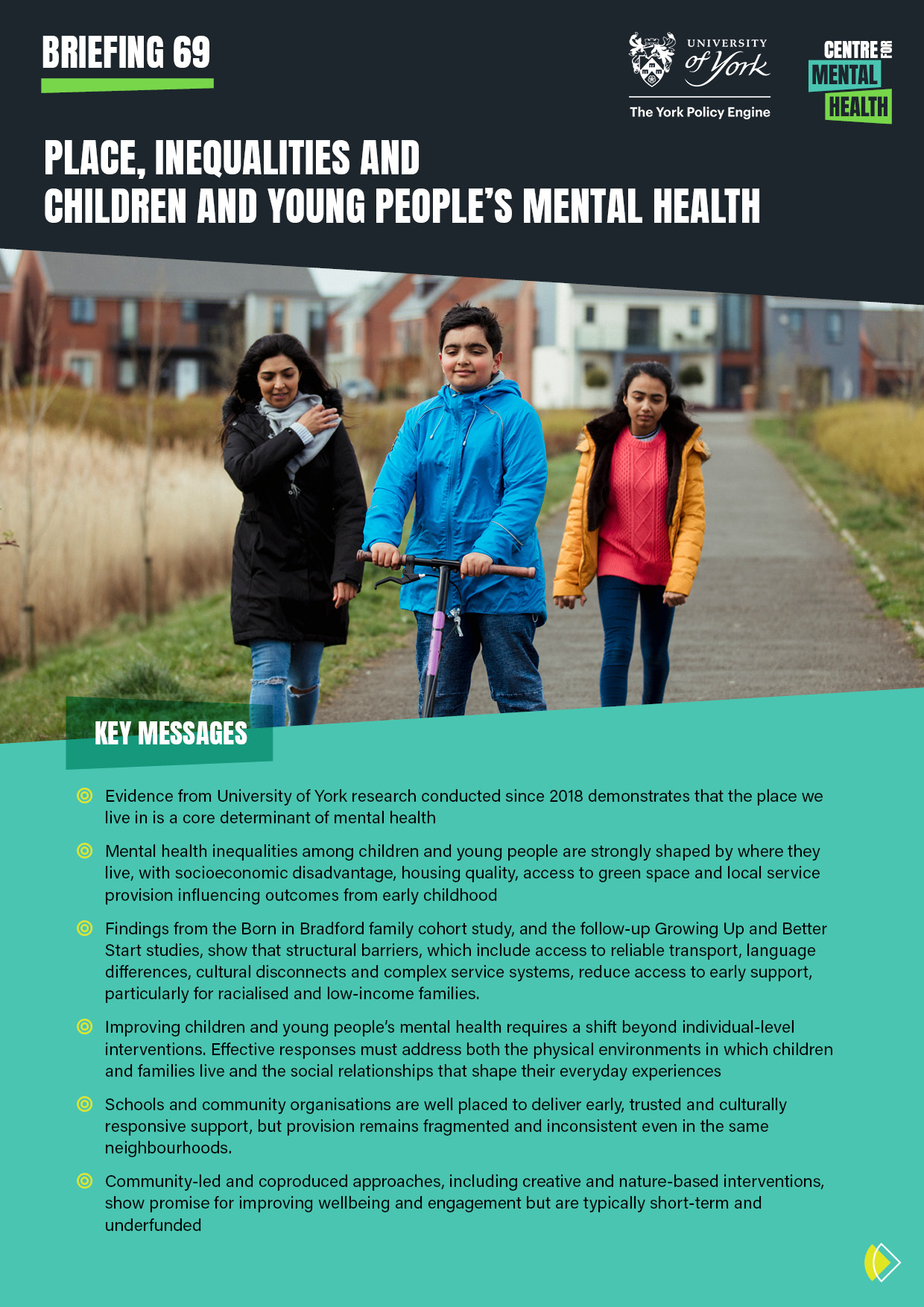
Our briefing, Place, inequalities and children and young people’s mental health, summarises recent research from the University of York, demonstrating how children’s mental health is strongly shaped by where they grow up, with mental health inequalities driven by poverty, poor quality and insecure homes, access to good quality green space, and access to culturally competent mental health support.
The briefing draws particularly on the Born in Bradford family cohort study, which has followed more than 12,000 children and families since 2007, and highlights how children living in areas of socioeconomic disadvantage experience substantially higher rates of anxiety and depression yet are less likely to access appropriate support than children living in more affluent areas.
Structural barriers reduce access to early support, particularly for racialised and low-income families. This includes unreliable transport, language differences, cultural disconnects and complex, fragmented services. Access to services depends more on administrative boundaries than on need, creating unequal access even between neighbouring streets.
The report calls for policy makers to design services that recognise how children’s mental health is shaped by the environment around them, and invest in long term in approaches that integrate mental health with environmental, education and housing policy.
It recommends that NHS children and young people’s mental health services adapt to the multicultural needs of the neighbourhoods they serve, including by fully adopting the Patient and Carer Race Equality Framework.
It calls on local and strategic authorities to adopt a ‘mental health in all policies’ approach to benefit children and young people’s mental health, for example by creating safer and friendlier and more accessible public spaces for play, social connection, and movement.
It also recommends that support is embedded within settings including schools and trusted community hubs, building on the strong support networks in many local communities that buffer stress and boost wellbeing.