
I have so much to say about trans Autistic mental health and no time, energy, or resources to dig deeper into my feelings. There is just too much to unpack. The socio-political violence towards transgender and Autistic people, and those of us who dare to be both, is becoming everyday ‘discourse’. Trans Autistic people are being used as inspiration for hatred which spans through and beyond our experiences of transphobia, ableism, racism and misogyny. Our pain is compounded by media who (re)purpose this violence to sell papers and clicks. Trans Autistic people, and other marginalised people, continue to face the brunt of worldwide and interpersonal violence – and we also have the least access to timely, appropriate, mental health support.
I could write a blog detailing the abject horrors of the growing socio-legal violence against trans people in the UK and elsewhere. I could consider how public figures without the appropriate background or expertise have written articles framing trans people as predatory and Autistic people as vulnerable to the supposed ‘trans agenda’. I could write about the real fear of being accosted in public toilets and changing rooms, the complex legalities which have confused businesses and public spaces about who can go into what rooms and under what circumstances.
I could reflect on the never-ending waiting lists for autism and gender incongruence diagnoses. I could make inferences about the timing of public debates about overdiagnosis aligning with women, girls and gender minorities finally being more readily diagnosed as Autistic. Ignoring that diagnosis does not guarantee the care or support we need.
I could write about how we are more likely to be under- or unemployed, have complicated relationships with drugs and alcohol, and are more likely to be unhoused or precariously housed. I could share the disproportionate suicide rates for Autistic and/or trans people, especially when we are such a small part of the UK and world population.
I could write all these things that trans Autistic people know so well, the things we hurriedly converse about every time we see each other. So many of our conversations are concerned with safety and access and being able to do the most mundane things without having to mask or pass. We do not want the persistent horrors to take over our minds or make us lock up our hearts for fear of being hurt, shunned, invalidated, hated and erased all at the same time.
For those of us who live, research or work within the trans Autistic intersection, it is easy to intellectualise our pain and hide it underneath clever word play or long lists of references. I have done this more than a few times, unintentionally, but my self-erasure happens all the same. Sometimes I find myself becoming numb as an automatic response to the overwhelming intensity of it all. A person and a community can only take so much. I need to allow myself to feel this rawness, but I don’t want pain to be the only thing I carry – the only thing I know about my transness and my autisticness. There is more to me, and to us, than pain and survival strategies.
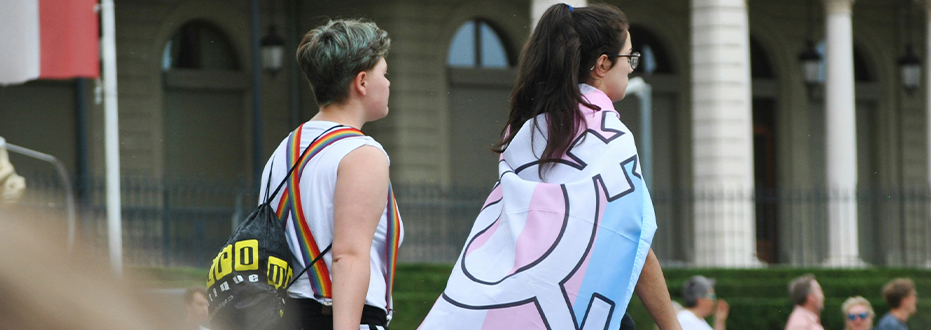
What I would love to focus on is joy, comfort, happiness, the sheer audacity of banality. I would like to write about my family and friends, my loved ones, and how we build towards a better future. I see this care and love already, in community-based blood testing for those on hormone replacement therapy, in DIY forums, mutual aid, and fundraisers for surgery. I see this in trans and Autistic community groups and the ever-growing acknowledgement, in the charity sector at least, of this intersection.
We are creating webs of care that centre our individual and collective mental wellbeing. We craft, protest, have fun, laugh, cry, make love, stim* and experiment with life. These are the ways we create spaces and futures for ourselves when it feels clearer than ever that such spaces will not be made for us. We are working out how to create more affordable and accessible mental health care at the grassroots, but we cannot stop there.
We need allies – strong, outspoken people within policy and practice – to make changes, to call out poor practice, and call on others to make mental health care more accessible and appropriate. We as trans Autistic people are exasperated with having to be strong and resilient and yet continuing to fall through the cracks in mental health care. We need support, we need love, and we need people like you standing up for us in every room and on every occasion.
*Stimming is shorthand for self-stimulatory behaviour, which is a way some Autistic people calm their nervous systems and show emotions.
Katie Munday (they/he) is a researcher focused on health care accessibility as a fundamental location of belonging, connection, and joy.