
Our new framework for a mentally healthier council aims to embed mental health as a core priority in all council strategies, policies, and operations — creating a mentally healthier environment for both residents and the workforce.
Developed by Centre for Mental Health, this framework is informed by feedback gathered through a survey distributed to members of the Mentally Healthier Councils Network in 2024. It reflects the criteria that local authorities identified as most relevant to supporting their ambition to become a mentally healthier council. The framework also incorporates practical insights from Worcestershire County Council, Leeds City Council, and Birmingham City Council, drawn from their experience of aligning local strategies with it. These councils identified areas where the framework could be strengthened and shared a range of initiatives and case studies that demonstrate how the criteria can be met.
- Leeds City Council: Public Mental Health Programme
- Worcestershire County Council: Reflections on the Mentally Healthier Councils Framework
- Birmingham City Council: Creating a Mentally Healthy City strategy
Our co-development approach with the network focused on testing, understanding, and exploring potential challenges, enabling us to learn collectively and refine the framework through shared experience.
The framework for a mentally healthier council consists of a 10-point checklist of approaches to embed mentally healthier policies and initiatives, clustered within five over-arching areas which align with the key social determinants of mental health. Each area outlines practical steps that councils can take to promote wellbeing and reduce risk factors that harm mental health. All are easily demonstrable, proven to have shown they will improve mental health, and not too costly to councils. These can be used to integrate what your organisation is already doing to support your community and workforce wellbeing and to strengthen your approach in building a mentally healthier council.
The framework sets out a clear, practical call to action for councils of all sizes to strengthen mental health and wellbeing across their communities and workforce. Grounded in prevention, early intervention, and evidence of what works, it recognises that councils start from different places and capacities. Through leadership, collaboration, and shared learning across the Mentally Healthier Councils Network, every council can play a vital role in improving mental health and reducing inequalities.
“Absolutely great stuff you’re doing. This tool that the Centre for Mental Health has produced is incredibly helpful. It allows us to some degree to quantify how we’re getting on and to be able to compare progress over time across areas. I think it’s absolutely invaluable, especially at a time when local authorities are facing the most extreme financial pressures” – Lisa McNally, Director of Public Health at Worcestershire County Council
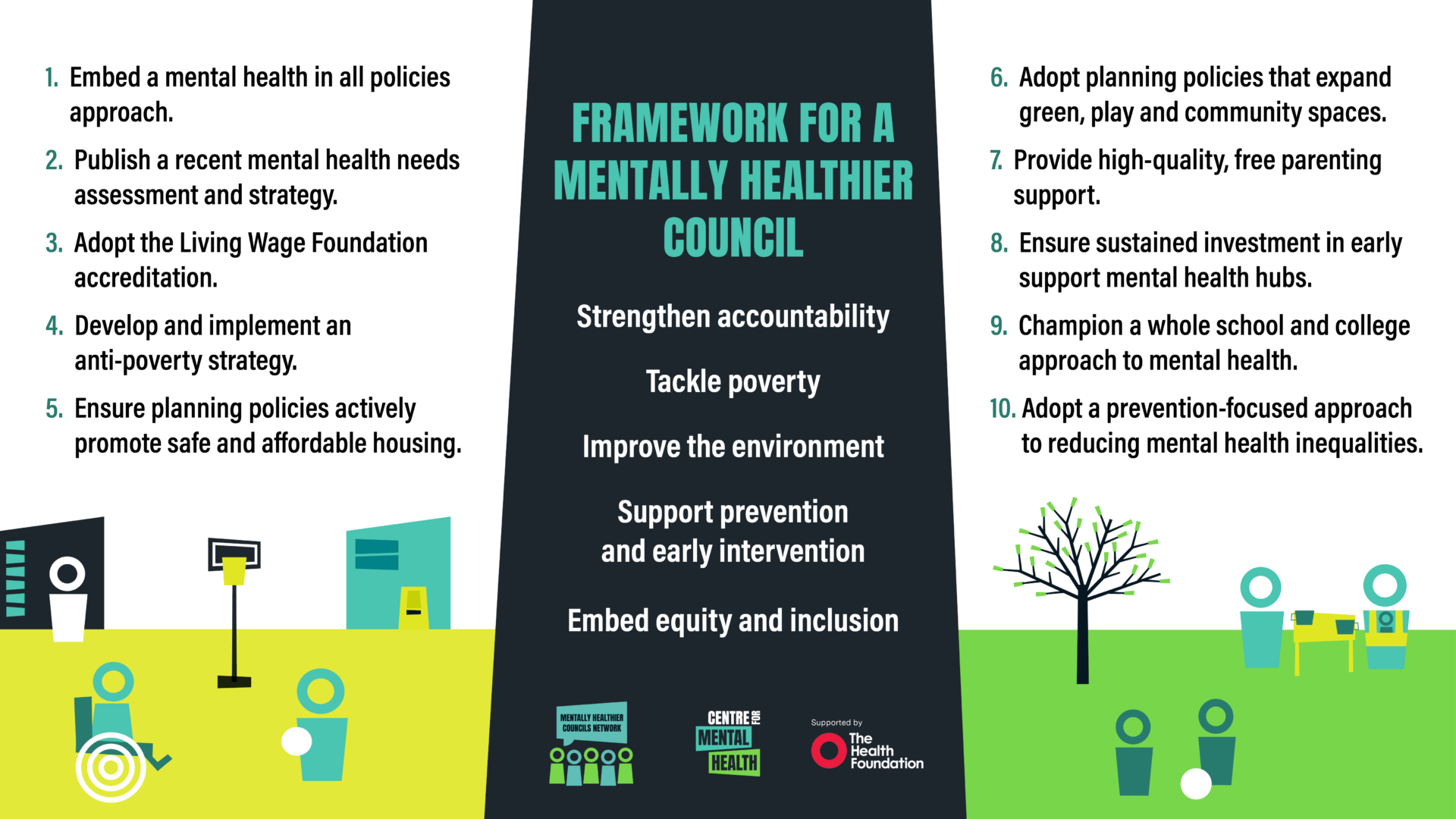
Framework for a mentally healthier council: A 10-point checklist
Strengthen accountability and prioritise mental health in all policies
1. Embed a mental health in all policies approach and apply a bespoke mental health policy test. Designate a named mental health champion – either an elected member or a Public Health Officer – to drive implementation, champion prevention, and ensure accountability at all levels.
Where capacity is limited, smaller councils should be supported through cross-council collaboration, including mentorship, shared expertise, and peer support from larger county or city councils.
2. Publish a recent mental health needs assessment and strategy coproduced with communities within the past five years and informed by lived experience and current priorities – what makes a good mental health needs assessment.
Strategies should clearly set out what works to improve mental health and reduce inequalities, the costs and benefits of interventions, and how investment in prevention and early intervention can deliver long-term savings and community benefit.
Actively involve residents, system partners, including the voluntary and community sector organisations, and people with lived experience in the design, delivery, and evaluation of mental health initiatives. Invest in community-based approaches that strengthen social connection and resilience.
Tackle poverty and reduce financial inequality to protect mental health
3. Adopt the Living Wage Foundation accreditation to ensure fair pay and a decent standard of living for all, including council staff and contractors. Become an accredited Living Wage Employer.
4. Develop and implement an anti-poverty strategy that includes: social value procurement; free, accessible financial, benefits, and employment advice; and, targeted support for communities at greatest risk of poor mental health.
Improve the environment and create places that actively support mental wellbeing
5. Ensure planning policies actively promote safe and affordable housing that is secure and accessible.
6. Adopt planning policies that expand green, play and community spaces while driving sustainable inclusive town centres that reduce isolation and enhance wellbeing.
Support prevention and early intervention for a mentally healthy start in life
7. Provide high-quality, free parenting support through Best Start Family Hubs and related programmes, giving every child the best start in life.
8. Ensure sustained investment in early support mental health hubs for children and young people, enabling timely access to care and support, reducing escalation to crisis services.
9. Champion a whole school and college approach to mental health and wellbeing, supporting integrated strategies across education settings.
Embed equity and inclusion and deliver fair and culturally responsive mental health support
10. Adopt a prevention-focused approach to reducing mental health inequalities by signing up to The Prevention Concordat for Better Mental Health.
The sign-up process for the Prevention Concordat is currently paused as the department is refreshing and looking to relaunch this year. Whilst this is being processed, you could consider working with mental health providers to deliver the Patient and Carer Race Equality Framework to embed racial justice within mental health services or aligning with the Marmot Places 8 principles where appropriate, ensuring services are accessible, inclusive, and shaped by communities who experience the poorest mental health outcomes.